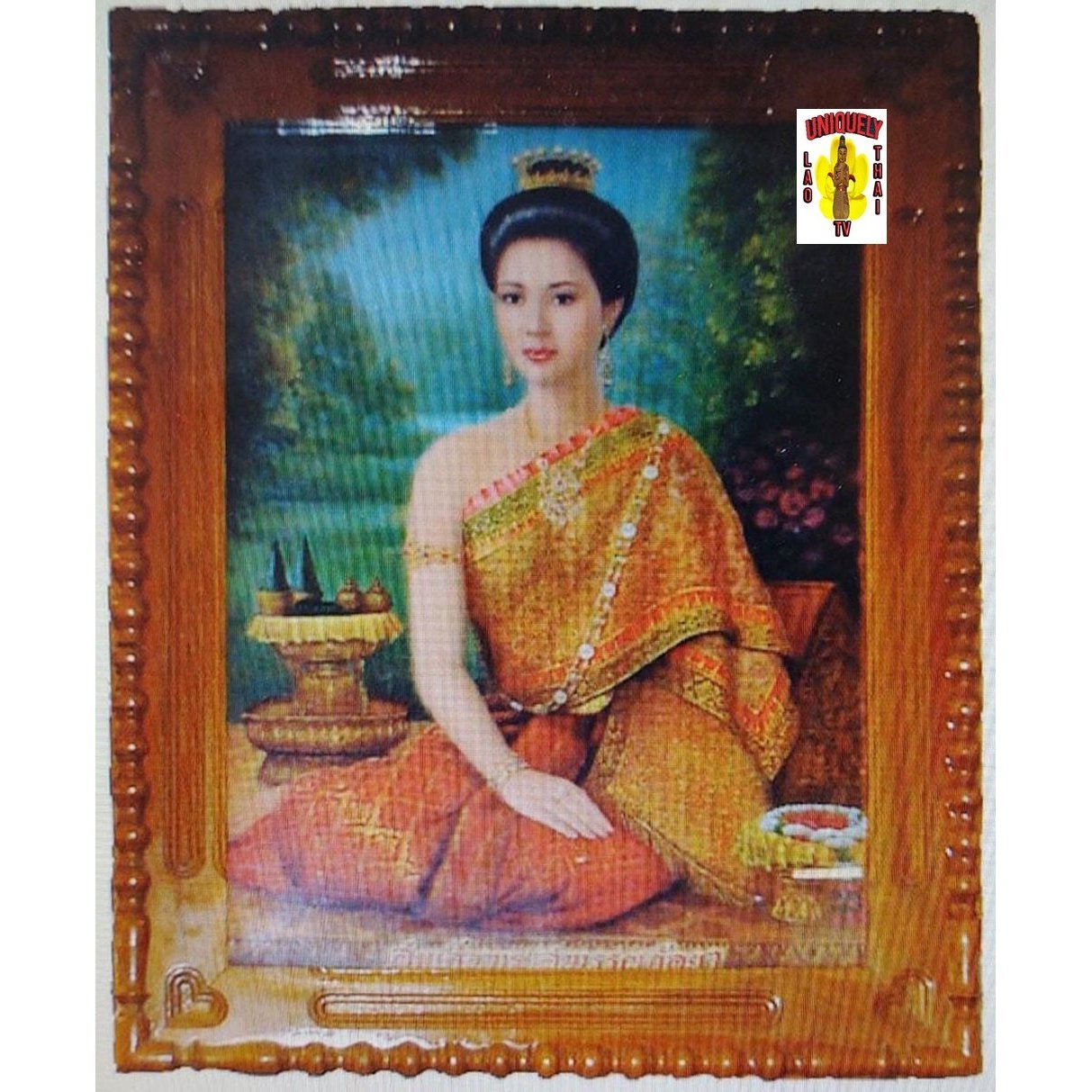
Teakwood Frame 18" x 28" with a Print of Thai Princess Suphankalaya
Teakwood Frame 18" x 28" with a Print of Thai Princess Suphankalaya
SKU:K-709
Couldn't load pickup availability
Framed print of Phra Suphankanlaya (สุพรรณกัลยา), the 16th-century Ayutthaya princess remembered as the elder sister of King Naresuan and King Ekathotsarot. The image comes in an artfully carved teakwood frame with a lacquer finish, available in sizes from 18 to 28 inches.
This is a reproduction print of the princess’s likeness, not an original oil. The piece's value lies in the subject, the carved teak frame, and the lacquer finish.
A finished piece for a home altar, study, or Thai cultural display. Dust the frame with a soft, dry cloth; avoid water and harsh cleaners on the lacquer.
Her story — what history actually records
Suphankanlaya (also written Suphankalaya; Pali-Thai Suvarṇakalyā, “golden lady”) was a daughter of Maha Thammaracha, viceroy of Phitsanulok and later king of Ayutthaya (r. 1569–1590), and Queen Wisutkasat, herself a daughter of King Maha Chakkraphat and Queen Suriyothai. This makes her Suriyothai's granddaughter and the elder sister of the princes who became King Naresuan and King Ekathotsarot. Tradition places her birth around B.E. 2095 / A.D. 1552 at Chan Palace in Phitsanulok. Some later accounts give her childhood name as Ong Thong.
After Ayutthaya fell to King Bayinnaung of Hongsawadi (Pegu) in 1569, the Phitsanulok royal house became a Burmese vassal. Burmese chronicle material records that the lord of Phitsanulok presented a daughter about seventeen years old, named Suwann / Bra Thawan, to Bayinnaung as a minor consort, together with attendants. Thai tradition dates this marriage alliance to 1571. In Burmese she is also associated with the name Bya Eindadewi (and, in some discussions of the sources, A Myo Yong). The political purpose is clear in the records we have: a marriage tie to bind her father’s loyalty. Popular Thai telling adds that this bond helped her brothers return from the Burmese court. Contemporary Ayutthaya royal chronicles say little about her by her later famous name; much of the detailed life story comes from Burmese notices and later Thai writing.
Bayinnaung died in 1581. Tradition holds that she then married his successor, Nanda Bayin. In 1584, her father broke the vassal oath; after his death in 1590, Naresuan continued the war. In January 1593, at Nong Sarai, Naresuan killed the Burmese crown prince Mingyi Swa (Thai tradition: the famous elephant duel; Burmese accounts differ on how the prince died).
What is not firmly proven: later Thai popular history says that when Nanda Bayin learned of his son’s death, he struck Suphankanlaya, who was then pregnant, and she died—often dated around 1593. That martyr account is widespread in modern Thailand and is why she is venerated as a woman who remained in Hongsawadi while her brothers fought for Ayutthaya. Historians note that this death scene is not documented in the early Ayutthaya chronicles; it belongs to later narrative and popular memory. What we can say with more confidence is the family line, the 1569–1571 hostage/marriage context, and her place in Ayutthaya–Hongsawadi politics.
She is honored today as a symbol of sacrifice for the kingdom, not because every later detail can be footnoted, but because the core is historical: a Phitsanulok-Ayutthaya princess given into the Toungoo court so her house—and, in the Thai telling, her brothers—could survive the years after the first fall of Ayutthaya.
Share
Low stock